City of Interzone
Naked LunchThe City of Interzone is both a densely inhabited city and a composite vision of human possibility: a place where peoples, histories, appetites, and imagined futures converge. Its vast market and crowded rooms offer an apparent openness, but that openness coexists with violence, illness, addiction, and schemes for directing other people’s bodies and minds.
Urban Form and Public Life
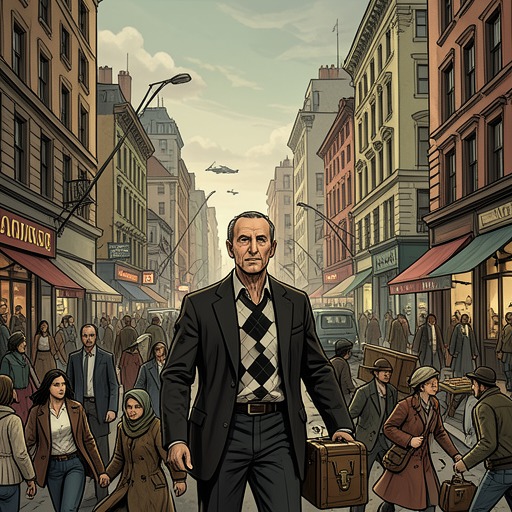
The city’s streets descend between deepening canyons into a vast, kidney-shaped plaza. Dwelling cubicles and cafes perforate the surrounding walls, some only a few feet deep and others opening into networks of rooms and corridors; bridges, catwalks, and cable cars cross the spaces at multiple levels. The result is not a city organized around a single street or center so much as a layered system of passageways and inhabited recesses.
The plaza’s darkness and its maze-like construction frame public life as constant movement among visible streets, hidden rooms, and improvised routes. Elsewhere, the city panorama opens on the Market, accompanied by the intermittent strains of “East St. Louis Toodleoo.” The music’s shifts from clarity to distance give the panorama a changing point of focus, as though the city were being apprehended from several places at once.
The setting’s apparent freedom is not equivalent to safety or privacy. The City is described as having no locked doors, and anyone may enter another person’s room at any time. A Chinese chief of police listens to accusations brought by a lunatic, while hipsters lounge in doorways with shrunken heads on gold chains. The ease of entry and the casual presence of denunciation sit uneasily together: access is unrestricted, but security and reliable authority are not assured.
The Composite City and the Market
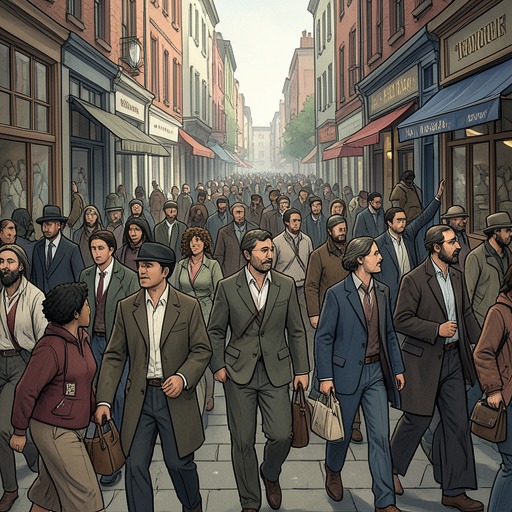
The Market makes the city’s variety explicit. Its panorama imagines the blood and substance of many peoples passing through a body: Negro, Polynesian, Mountain Mongol, Desert Nomad, Polyglot Near East, and Indian, alongside combinations not yet realized. Migrations across deserts, jungles, mountains, and the Pacific culminate in the image of the Composite City as a silent market where human potentials are laid out together. This is not simply a catalogue of neighborhoods; it is a vision of identity and history as crossings that can be experienced within one body.
That vision is set against the concrete bustle of the Market. Behind open doors are tables, booths, bars, kitchens, and baths, with people eating, talking, bathing, and smoking. The scene gathers ordinary social activity alongside drug use and sexual life, while the surrounding city also suffers recurring epidemics of violence and leaves untended dead in the streets. The Market’s abundance therefore does not resolve into uncomplicated harmony: plurality and vulnerability occupy the same urban space.
The Meet Cafe concentrates the Market’s extraordinary trades and services. Its visitors include practitioners of obsolete crafts, users of drugs not yet synthesized, sellers of souped-up Harmaline and liquids that induce Latah, black marketeers dealing in World War III, and brokers trading dreams and memories. Doctors treat diseases associated with ruined cities, while investigators, warrant servers, and officials represent fragmentary or unconstituted authorities. The cafe is a point where the unknown past and an emergent future meet, not through a stable civic institution but through a jumble of commerce, medicine, investigation, and speculation.
Yage and the Experience of the City
The account identifies its description of the City and the Meet Cafe as written in a state of Yage intoxication. Notes on that state describe images falling slowly and silently, a sense of serenity, and the collapse of defenses: everything seems free to enter or leave. In another recorded passage, the room takes on qualities associated with the Near East, Africa, and the South Pacific, while the observer’s imagined bodily identity shifts among those cultural forms. The city’s composite character is thus bound to altered perception, not presented solely as an objective map.
The text names Yage, Ayuahuasa, Pilde, and Nateema as Indian names for Banisteria Caapi, a fast-growing vine indigenous to the Amazon region. It also describes Yage as a means of space-time travel. In this account, sensations of movement and cultural transformation produce the panorama of peoples, migrations, and unrealized combinations. The city becomes a structure for registering that experience: a place where the observer encounters history and possibility as things passing through the body.
The account also gives Yage a divinatory and medical context. It says medicine men use it to foretell the future, locate lost or stolen objects, diagnose and treat illness, and identify the perpetrator of a crime. The accompanying explanation describes a worldview in which death is not treated as accidental and may be attributed to an alien or hostile will. Yage’s role in the City’s imaginative geography therefore extends beyond sensation: it provides a means, within the described belief system, of seeking knowledge about events and responsibility.
Control, Commerce, and Narrative Significance
The City’s open rooms and crowded markets form a striking contrast with the technological programs of control described elsewhere in the book. At a conference in Chicago, a speaker proposes biocontrol through bioelectric signals injected into a subject’s nervous system. The scheme could involve a miniature radio receiver installed in the brain shortly after birth; the speaker also says drugs or other processing might make a person susceptible without implanted equipment. He presents the biocontrol apparatus as a prototype for one-way telepathic control and imagines transmitters ultimately replacing the apparatus. These proposals make the body an interface for imposed direction, sharply at odds with the Market’s apparent profusion of lives and exchanges.
That contrast connects the City’s shifting identities to the book’s wider concern with who may enter, influence, or command another person’s experience. The Market’s openness can mean mixture and passage, but it can also expose inhabitants to intrusion, disease, violence, and systems that treat feeling as something to be transmitted or manipulated. As a location, the City gathers these opposed possibilities into one unstable whole: a composite urban world where no single culture, authority, or account of reality can contain what passes through it.